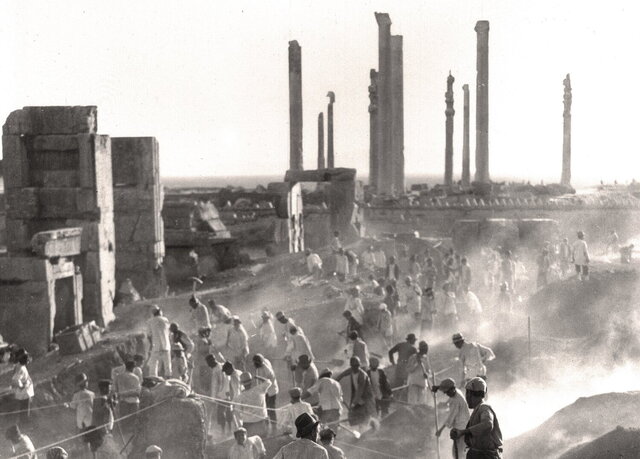
He left Iran at the end of 1934 for a year in London, but never returned. In 1935, he was forced to leave his position in Germany because of his Jewish descent, and became a faculty member of the New Jersey Institute for Advanced Study from 1936 to 1944. He died in Basel, Switzerland in 1948. The bulk of the Ernst Herzfeld Papers are housed in the archives of the Freer Gallery of Art and the Arthur M. Sackler Gallery, Smithsonian Institution, in Washington, DC. The material, some 30,000 documents include his field notebooks, photographs, drawings and object inventories from his excavations at Samarra, Persepolis, Pasargadae and elsewhere in Iraq, Turkey and Syria. The archives are open by appointment Tuesdays, Wednesdays and Thursdays, from 10 a.m. to 5 p.m.
Other Herzfeld research materials, notes, photographs and drawings are at the Metropolitan Museum of Art, in the Departments of Islamic Art and Ancient Near Eastern art. In fact, there’s another correlation between the exhibition and von Busse’s photographs: both include images of Achaemenid sculptural reliefs from Persepolis. “The Qajars were really interested in pre-Islamic dynasties, and in linking themselves to those dynasties,” said Schwerda, who also worked on the Technologies of the Image exhibition and contributed to its catalogue.