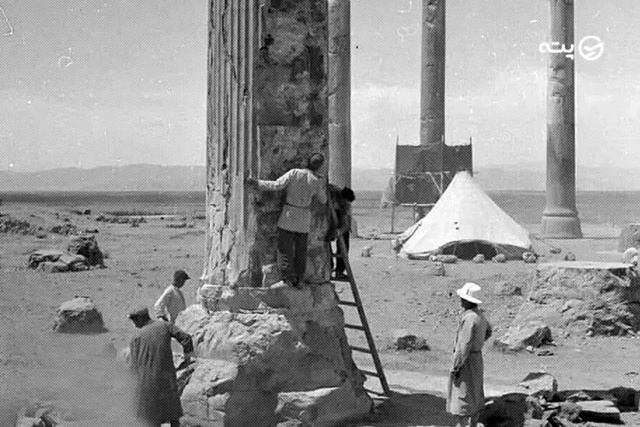
Herzfeld’s work as a Near Eastern scholar has a lasting legacy, and these images offer an intimate and personal glimpse into a key stage of his life and career. The year 1934 was Herzfeld’s last at Persepolis. As a German archaeologist who was also Jewish, he left the excavation and eventually joined the faculty of the Institute for Advanced Study in Princeton, New Jersey; he never returned to Persepolis. Von Busse, who also left the site in 1934, had only one set of published Persepolis photographs to his name—panoramic photographs of the striking eastern staircase facade of the Apadana, which were printed in the Illustrated London News.
He continued taking photographs as part of future jobs, but “his work was never really appreciated,” Schwerda said. With the Harvard Art Museums’ installations of his photographs, a short but important period from von Busse’s life is finally getting attention. Persepolis — known in Persian as Takht-e Jamshid — is one of the most iconic ancient sites, located about 60 km northeast of Shiraz in Fars Province. As the ceremonial capital of the Achaemenid Empire, Persepolis stands as a powerful symbol of Persian history, art, and architecture.