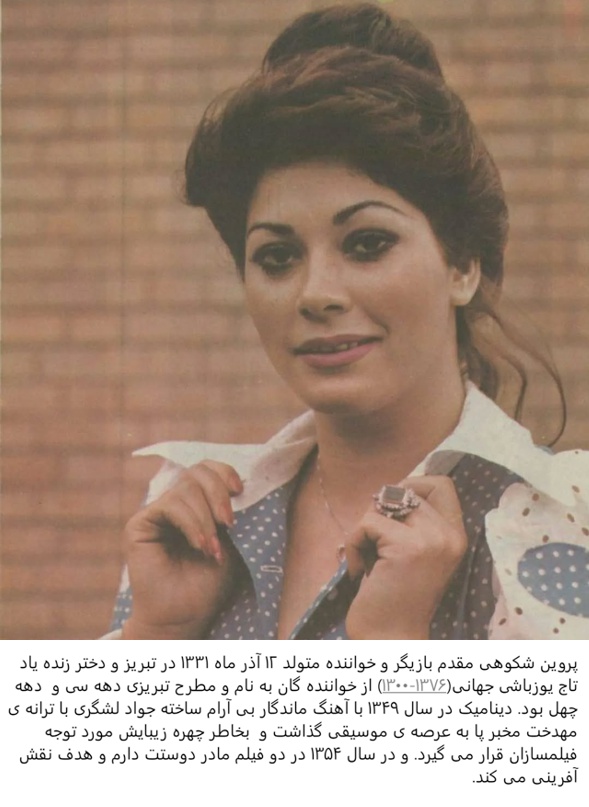
Parvin Shokoohi Moghadam (born December 1, 1952, in Tabriz) is an actress and singer whose artistic roots trace back to a culturally rich family. She is the daughter of Taj Yozbashi Jahani (1937–1987), one of Tabriz’s most celebrated singers of the 1930s and 1940s, whose powerful voice and influential performances left a lasting imprint on the region’s musical heritage. Growing up surrounded by music, Parvin developed a deep passion for the arts at a young age. Her entry into the world of music came in 1960, when she performed the song “Madager Biaram,” composed by Javad Lashgari, with lyrics by Mahdakht Mokhbar. The song’s success brought her immediate attention, not only for her vocal talent but also for her captivating presence. Her rising popularity soon attracted filmmakers, and Parvin transitioned into acting as well. In 1975, she appeared in two motion pictures—“Madar Doost Daram” and “Khafb”—which marked her official debut in cinema. Her performances, known for their emotional depth and authenticity, introduced her to a broader national audience and cemented her place among notable actresses of the era. As her fame grew, so did interest from film directors and producers. Parvin’s striking features and graceful appearance caught the attention of filmmakers seeking new talent for the rapidly expanding cinema industry of the 1970s. These roles showcased her ability to convey emotion through subtle expressions and authentic performances. Although primarily known as a singer, Parvin proved she could transition seamlessly into acting, gaining respect from industry professionals and viewers alike. Parvin Shokoohi Moghadam’s artistic identity was shaped by her dual talents. As a singer, she honored Azerbaijani musical traditions while embracing modern compositions. As an actress, she brought sincerity and quiet strength to the screen. Despite the challenges faced by female artists in her era, Parvin carved a distinct place for herself through dedication, talent, and authenticity. These works combine a musical score and a libretto, or text, and are typically accompanied by an orchestra. The live performances incorporate stage acting, costumes, scenery, and often dancing. Actors may work in a variety of settings, including theater, film, television, and radio. Some actors work exclusively in one medium, while others work across multiple mediums. They may also work on stage productions, commercials, or voiceovers for animated films or video games. Acting requires a combination of talent, training, and experience, as well as a willingness to work long and irregular hours. The traditional opera season lasts from about September through May. For singers who are booked with a show, their workday generally begins very early and can last well into the evening, with performance days often extending late into the night. Actors play a crucial role in the entertainment industry, as they are responsible for bringing stories and characters to life. They use their talents to create compelling performances that engage audiences and help to transport them to different worlds. Actors have the ability to evoke a wide range of emotions in their audiences, from laughter to tears, and can help to shape the way that people view the world around them. They will have already memorized the entire opera before rehearsals even begin. When a performance is cast, the entire group begins with a run-through of the piece. They spend the next two to three weeks staging the opera. In addition to their artistic contributions, actors also have a significant impact on the economy. The entertainment industry generates billions of dollars each year, and actors are a critical component of this industry. They provide employment opportunities for other professionals in the industry, such as directors, producers, and writers, and contribute to the growth of local economies in areas where filming takes place. After that, opera singers will have one entire run-through with the orchestra, plus two dress rehearsals before the actual performances begin. Stage actors typically work in theaters, which can range from small community venues to large Broadway theaters. These spaces often have dressing rooms, rehearsal spaces, and other facilities to support the production. nd celebrated, with many receiving awards and accolades for their performances. The work of actors is also widely recognized During the fourth week, called tech week, they move into the theater and practice the piece in costume for the first time, perfecting each note and each step using props and lighting. During rehearsals, actors may spend long hours in these spaces, working through scenes and developing their performances. Once the production is open, actors may perform multiple shows a week, with performances taking place in the evenings and on weekends. If a singer isn't currently booked into an opera, that doesn't mean they can afford to take time off. Opera singing is completely entrepreneurial, which means you must constantly be auditioning for new parts. Opera singers without current gigs spend their days taking voice lessons, practicing for recitals, attending performances, and learning musical pieces to use in future shows. Film actors, on the other hand, may work on location or in studios. On location shoots may take place in a variety of settings, from city streets to remote wilderness areas. Actors must be able to adapt to different environments and work in challenging conditions, such as extreme temperatures or long hours. Parvin Shokoohi Moghadam (born December 1, 1952, in Tabriz) is an actress and singer whose artistic roots trace back to a culturally rich family. She is the daughter of Taj Yozbashi Jahani (1937–1987), one of Tabriz’s most celebrated singers of the 1930s and 1940s, whose powerful voice and influential performances left a lasting imprint on the region’s musical heritage. Growing up surrounded by music, Parvin developed a deep passion for the arts at a young age. Her entry into the world of music came in 1960, when she performed the song “Madager Biaram,” composed by Javad Lashgari, with lyrics by Mahdakht Mokhbar. The song’s success brought her immediate attention, not only for her vocal talent but also for her captivating presence. Her rising popularity soon attracted filmmakers, and Parvin transitioned into acting as well. In 1975, she appeared in two motion pictures—“Madar Doost Daram” and “Khafb”—which marked her official debut in cinema. Her performances, known for their emotional depth and authenticity, introduced her to a broader national audience and cemented her place among notable actresses of the era. The most successful opera singers are driven, work well with other people, love to learn, and are self-motivated. Self-care is very important in this job, so healthy eating and exercise must be priorities. In studio settings, actors may work on soundstages, which are large indoor spaces designed to mimic real-world environments. They may also work in front of green screens, which allow special effects to be added later in post-production. Voice actors may work in recording studios, where they record dialogue for animated films or video games. These studios are often small and soundproof, with high-quality microphones and other equipment to capture the actor's voice. Voice actors may work alone or with other actors, depending on the project. Regardless of their specialization, actors must be able to work collaboratively with other members of the production team, including directors, producers, and other actors. They must also be able to adapt to changing schedules and be flexible in their availability. Actors may spend a lot of time auditioning for roles, which can be a competitive and often unpredictable process. A singer uses their voice to create music and convey emotions through lyrics and melody. Singers can specialize in various genres, such as pop, rock, country, jazz, opera, and classical music. Singers are essential components of musical ensembles, such as bands, choirs, and orchestras, or they can perform solo on stage or in a recording studio. Singers need to have excellent vocal skills, including pitch, range, control, and expression, as well as a good ear for music and the ability to read sheet music or lyrics. They also need to be comfortable performing in front of an audience and have stage presence and charisma to engage and entertain their listeners. The workplace of a singer can vary greatly depending on their specific career path and level of success. For some singers, their workplace may be a small local venue or a street corner where they perform for tips. For others, it could be a large concert arena or a recording studio. One common workplace for singers is the stage. Whether performing in a musical theater production, a concert tour, or a local gig, the stage is where singers showcase their talent and connect with their audience. Onstage, singers must project their voice and express themselves through movement, facial expressions, and stage presence. The stage can be a thrilling but also nerve-wracking environment, as performers must often deal with stage fright and the pressure of live performance. In addition to the stage, many singers spend a significant amount of time in the recording studio. In the studio, singers work closely with producers and sound engineers to create and perfect their music. They may spend hours recording vocal tracks, experimenting with different sounds and effects, and fine-tuning their performances. The recording studio can be a more controlled environment than the stage, but it still requires a high level of focus and dedication to get the desired results. Singers also often spend time in rehearsal spaces, where they prepare for upcoming performances or recordings. During rehearsals, singers may work with a band or orchestra to coordinate their performance and perfect their timing. They may also practice choreography and work on their stage presence. Rehearsals can be grueling and repetitive, but they are essential to ensuring a successful performance. A singer uses his or her voice to generate music by vocalizing musical sounds with tone and pitch. Singers may perform individually or in groups, and instrumental music is frequently accompanied. In technical terms, singing is a physical process in which air traverses through the larynx, throat, and mouth. The vocal resonation in singing involves seven parts of the human body: the chest, tracheal tree, larynx, pharynx, oral cavity, nasal cavity, and sinuses. A singer is an artist or performer who uses numerous techniques and training to create a vocal song. Singers train regularly and appoint professional voice teachers to aid them in refining their craft. Singers might also compose their music or perform on music composed by others. Singers also work as music teachers or voice coaches and sing to pay their bills. Parvin Shokoohi Moghadam (born December 1, 1952, in Tabriz) is an actress and singer whose artistic roots trace back to a culturally rich family. She is the daughter of Taj Yozbashi Jahani (1937–1987), one of Tabriz’s most celebrated singers of the 1930s and 1940s, whose powerful voice and influential performances left a lasting imprint on the region’s musical heritage. Growing up surrounded by music, Parvin developed a deep passion for the arts at a young age. Her entry into the world of music came in 1960, when she performed the song “Madager Biaram,” composed by Javad Lashgari, with lyrics by Mahdakht Mokhbar. The song’s success brought her immediate attention, not only for her vocal talent but also for her captivating presence. Her rising popularity soon attracted filmmakers, and Parvin transitioned into acting as well. In 1975, she appeared in two motion pictures—“Madar Doost Daram” and “Khafb”—which marked her official debut in cinema. Her performances, known for their emotional depth and authenticity, introduced her to a broader national audience and cemented her place among notable actresses of the era. Parvin Shokoohi Moghadam (born December 1, 1952, in Tabriz) is an actress and singer whose artistic roots trace back to a culturally rich family. She is the daughter of Taj Yozbashi Jahani (1937–1987), one of Tabriz’s most celebrated singers of the 1930s and 1940s, whose powerful voice and influential performances left a lasting imprint on the region’s musical heritage. Growing up surrounded by music, Parvin developed a deep passion for the arts at a young age. Her entry into the world of music came in 1960, when she performed the song “Madager Biaram,” composed by Javad Lashgari, with lyrics by Mahdakht Mokhbar. The song’s success brought her immediate attention, not only for her vocal talent but also for her captivating presence. Her rising popularity soon attracted filmmakers, and Parvin transitioned into acting as well. In 1975, she appeared in two motion pictures—“Madar Doost Daram” and “Khafb”—which marked her official debut in cinema. Her performances, known for their emotional depth and authenticity, introduced her to a broader national audience and cemented her place among notable actresses of the era. Parvin Shokoohi Moghadam (born December 1, 1952, in Tabriz) is an actress and singer whose artistic roots trace back to a culturally rich family. She is the daughter of Taj Yozbashi Jahani (1937–1987), one of Tabriz’s most celebrated singers of the 1930s and 1940s, whose powerful voice and influential performances left a lasting imprint on the region’s musical heritage. Growing up surrounded by music, Parvin developed a deep passion for the arts at a young age. Her entry into the world of music came in 1960, when she performed the song “Madager Biaram,” composed by Javad Lashgari, with lyrics by Mahdakht Mokhbar. The song’s success brought her immediate attention, not only for her vocal talent but also for her captivating presence. Her rising popularity soon attracted filmmakers, and Parvin transitioned into acting as well. In 1975, she appeared in two motion pictures—“Madar Doost Daram” and “Khafb”—which marked her official debut in cinema. Her performances, known for their emotional depth and authenticity, introduced her to a broader national audience and cemented her place among notable actresses of the era. Parvin Shokoohi Moghadam (born December 1, 1952, in Tabriz) is an actress and singer whose artistic roots trace back to a culturally rich family. She is the daughter of Taj Yozbashi Jahani (1937–1987), one of Tabriz’s most celebrated singers of the 1930s and 1940s, whose powerful voice and influential performances left a lasting imprint on the region’s musical heritage. Growing up surrounded by music, Parvin developed a deep passion for the arts at a young age. Her entry into the world of music came in 1960, when she performed the song “Madager Biaram,” composed by Javad Lashgari, with lyrics by Mahdakht Mokhbar. The song’s success brought her immediate attention, not only for her vocal talent but also for her captivating presence. Her rising popularity soon attracted filmmakers, and Parvin transitioned into acting as well. In 1975, she appeared in two motion pictures—“Madar Doost Daram” and “Khafb”—which marked her official debut in cinema. Her performances, known for their emotional depth and authenticity, introduced her to a broader national audience and cemented her place among notable actresses of the era. Parvin Shokoohi Moghadam (born December 1, 1952, in Tabriz) is an actress and singer whose artistic roots trace back to a culturally rich family. She is the daughter of Taj Yozbashi Jahani (1937–1987), one of Tabriz’s most celebrated singers of the 1930s and 1940s, whose powerful voice and influential performances left a lasting imprint on the region’s musical heritage. Growing up surrounded by music, Parvin developed a deep passion for the arts at a young age. Her entry into the world of music came in 1960, when she performed the song “Madager Biaram,” composed by Javad Lashgari, with lyrics by Mahdakht Mokhbar. The song’s success brought her immediate attention, not only for her vocal talent but also for her captivating presence. Her rising popularity soon attracted filmmakers, and Parvin transitioned into acting as well. In 1975, she appeared in two motion pictures—“Madar Doost Daram” and “Khafb”—which marked her official debut in cinema. Her performances, known for their emotional depth and authenticity, introduced her to a broader national audience and cemented her place among notable actresses of the era.