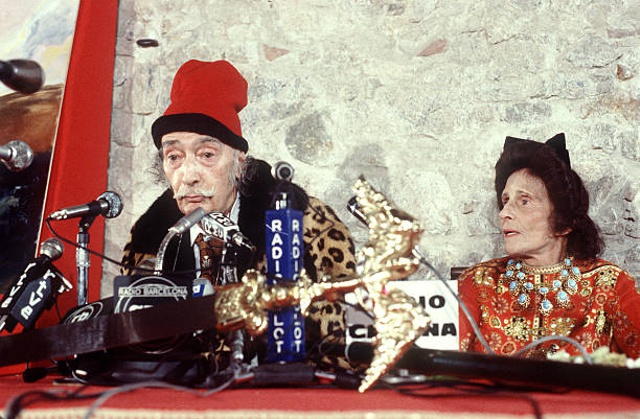
In summer 1929, several members of Europe’s surrealist art society descended on the coastal town of Cadaqués, in the Catalonia region of northeast Spain, to meet with a promising young painter named Salvador Dalí. Dalí had signed on for what was to be his first solo exhibition in Paris in November, but he was displaying all sorts of odd behavior, including uncontrollable fits of laughter. The visiting group, which included French poet Paul Éluard, worried that the talented but eccentric artist would be unable to focus on finishing enough pieces to fill the gallery space.
Dalí seemed intrigued by Éluard’s Russian wife, born Elena Dmitrievna Diakonova but known simply as Gala, so she was tasked with communicating with their host. Gala weathered his jarring outbursts, realizing they stemmed from social awkwardness, and, eventually, the laughing fits disappeared. In the meantime, she discerned him to be a true visionary and capable of spurring, as he theorized in his autobiography The Secret Life of Salvador Dalí, the “fulfillment of her own myth.”