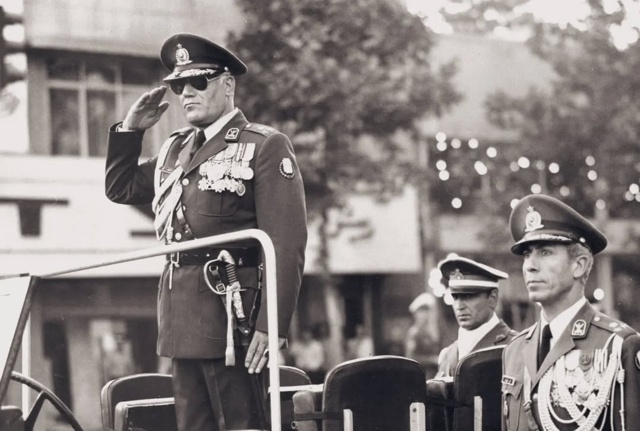
News and information regarding the execution of Major General Ali Neshat, son of Ahmad, was obtained from an Abdorrahman Boroumand Center interviews conducted with his daughter on January 31, 2021 and May 11, 2021 (ABC interview), three electronic forms submitted to the Boroumand Center on February 9, 2006, December 7, 2007, and October 20, 2009, by persons who knew him. Additional information about this case was obtained from Shirin Neshat’s memoirs in a website named after General Ali Neshat, and from Kayhan newspaper (January 24, and February 1, 1979; January-February 1979; March 27, and April 11, and 12, 1979); Ettela’at newspaper (April 11, 1979); Ayandegan newspaper (April 12, 1979); and ISNA (February 8, 2015). News of this execution was also published in Amnesty International’s February-March 1980 report. * General Neshat was born in Tehran in 1923. Upon graduating from high school, and subsequently from the Military University, he began serving in the “Guard Javidan” or the Imperial Guard (literally meaning the “Eternal Guard”). He was married and had five children. He was fluent in English and French. He was also an accomplished athlete and had obtained a multitude of medals in fencing, shooting (marksmanship), high jump, equestrian sports, and swimming. General Neshat was Moslem and a Safi Alishah Dervish. (Shirin Neshat’s memoirs; Electronic form). General Neshat served in various cities including Behbahan, Tabriz, Chabahar, and Kermanshah. He was appointed Commander of the Imperial Guard in December 1978. He was deployed and positioned in all the locations where the Royal Family had residences, and had an office in both the Niavaran and Sa’adabad Palaces. During his years of service, he had been awarded numerous medals and decorations. According to his daughter, General Neshat had great love and loyalty for his country and his king, and accompanied the Shah in all his domestic and international trips. (Shirin Neshat’s memoirs). General Neshat is remembered as a diligent and hard-working man who never disrespected any one. According to his daughter, he was extremely kind, brave, serious, and honest, and treated his subordinates (his officers) as if they were his own children. (Shirin Neshat’s memoirs). In the course of the 1978 protests, and more specifically on September 8, the day that came to be known as Black Friday, Yahya Nuri, a revolutionary cleric, called on the people to go to Jaleh Square and conduct a large protest demonstration against the government. The Tehran Military Commander had declared Martial Law at 6 o’clock in the morning of that same day, prohibiting gatherings of more than 3 people. Military forces who had taken up positions in Jaleh Square since very early that morning, tried to disperse the protesters by calling on them [to leave] through loudspeakers as soon as they saw them. The protesters did not heed the calls, however, and defied them, resulting in the military opening fire on and killing a large number of the protesters. The September 8 events widened the rift and increased the tension between the people and the government. After Black Friday, there were more demonstrations and more extensive street skirmishes in cities across the country. The Tehran Military Command announced that there had been 87 dead and 205 wounded in the incident. The government opposition announced the number of people killed on September 8, was more than 4000, and stated that 500 people had been killed in Jaleh Square. According to the tally published years later based on documents available at the Islamic Revolution Shahid (“Martyr”) Foundation, 88 individuals had been killed on September 8, 64 in Jaleh Square and another 22 in other locations in Tehran. At 12 noon on December 11, 1978, the day of the Ashura (the day of the martyrdom of Hossein, the fourth Shiite Imam and the Prophet Mohammad’s grandson), a soldier and a non-commissioned officer who had planned an attack on the Lavizan Military Base, carried out an assault on the Base cafeteria where there were a large number of officers present, opening fire and killing several people and ultimately getting killed themselves. (ISNA, February 8, 2015). On February 9, 1979, after the footage of Khomeini’s arrival and welcoming ceremonies were shown at the Dushan Tappeh Air Force Base, a fight broke out between Air Force trainees who supported Khomeini, and the Imperial Guard, resulting in altercations and shootings. Once news of the rioting at the Air Force Base broke out, a group of revolutionaries went to Dushan Tappeh and entered the Base to assist the rioters. They accessed the arms depot, and once armed with rifles and machine guns, and upon constructing street barricades, engaged in an armed conflict with the Imperial Guard. (ISNA, February 8, 2015). According to a BBC report, the news that there was an armed incident in one of Tehran’s military training centers on February 9, that had resulted in a number of deaths, was a rumor. In its Announcement Number 40 dated February 10, 1979, Tehran Military Command emphasized that on Friday night, February 9, during the hours of martial law, the people had taken advantage of the verbal altercation between Air Force trainees, and had spread rumors around town, thereby getting people to the streets and on rooftops, preventing the Command’s military operations. Ultimately, military forces were able to disperse the population at 4 AM on February 10. On March 27, 1979, the Islamic Revolution Prosecutor General’s office published the names of 24 officers who had been arrested, including General Neshat, in Kayhan newspaper. According to General Neshat, on February 13, he had been asked to report to duty, and he had appeared before the Alavi Committee on February 17. (Kayhan newspaper, April 12, 1979). According to General Neshat’s daughter, his father was arrested and taken to Qasr Prison after he had not accepted the position of Commander of the National Guard, offered to him by the Provisional Government’s Defense Minister (General Madani). During the period he was detained, his family would go to the Prison every Wednesday in the hopes of seeing him, but they were never allowed visitation. The officials would only take the things or the food they had taken there from them to give to him. (ABC interview, January 31, 2021). Tehran Islamic Revolutionary Court, Branch One, tried General Neshat in the afternoon of April 10, 1979. In that court session, which started in the morning of April 10, and continued until midnight, the cases of 11 individuals were adjudicated in the presence of reporters and photographers. (Kayhan and Ettela’at newspapers, April 11, 1979). According to an Ettela’at newspaper report, the charges against Major General Ali Neshat were stated to have been, “according to the indictment issued by the Revolutionary Prosecutor, Mofsed fel-Arz (“one who spreads corruption on Earth”) and Mohareb (“one who wages war”) with God and His Messenger (the Prophet Mohammad) and the Imam of Time, Peace Be Upon Him’s Deputy (By the Imam of Time it is meant the twelfth Imam in the Shiite religion, said to have vanished and is to come back one day to bring peace on Earth. By his Deputy, it is meant Ayatollah Khomeini, who was said to be his Deputy)”. The Revolutionary Court did not publish the details of the charges against General Ali Neshat, but the “judges” accused him in court of “putting himself and the entire body of the subordinates under his command at the disposal of the Tehran Military Command at the time where Field Marshal Oveissi was Military Commander of Tehran, to ensure that the plans of said Command ... for the suppression of the fighting people were carried out in the best possible way”. General Neshat’s loyalty to the Shah, his role in the suppression of the protesters “by positioning the Imperial Guard tanks at the Dushan Tappeh military bases”, and the destruction of certain documents, were among some of the charges leveled by the “judges” against him. In his defense, General Neshat alluded to a charge regarding the map of Kurdistan but available sources have not published any information regarding said charge. (Ettela’at newspaper, April 11, 1979). Field Marshal Oveissi’s commendation letter was read in court as evidence against General Neshat. The Revolutionary Court “judges” also brought up the matter of protecting royal palaces [from intrusion]; General Neshat not joining the revolutionary forces after the Qom, Tabriz, and Tehran protests; and his loyalty to the royal family against General Neshat, and stated: “You were there yourself on February 10, and you have written a statement at the Investigating Judge’s office [stating] ‘those under my command and I, myself, were guarding the palaces’. Explain a little bit what this means; ‘I guarded the palaces’ means ‘if the people wanted to come and take over these palaces [that belong to them but have been] seized [by the royals], I had the mission of defending them and opening fire on the people, shooting them, so they couldn’t have access to [and take over] these palaces’.” (Ettela’at newspaper, April 11, 1979). General Neshat denied the charges brought by the court. He believed that he was innocent and that all he had done was to stand by the oath of allegiance he had taken to the flag, the King, the country, and the people, and that he had carried out his duty. According to his daughter, in his defense writings, he had emphasized that he was a soldier and it was his responsibility to follow the orders from his superior, and was ready to sacrifice himself”.(ABC interview – May 11, 2021) In defending himself against the charge of Mohareb with God, he stated in court: “I come from a religious and dervish family and have never waged war against God, God’s Messenger, and the Imam of Time’s (Peace Be Upon Him) Deputy.” He stated in his defense that he had never participated in “the mass murder of innocent people”, and had put his forces at the disposal of the Tehran Military Command on the orders of his superior officer and had “never commanded those forces and their operations”. He further stated that a military mission is not predicated upon having to kill someone, and even though he had never participated in the [Tehran] Military Command’s [mission], he believed that the laws and regulations governing the Military Command were conditioned upon rendering the country safe and restoring security, not killing the people. He continued: “The Imperial Guard’s [duty] is to protect royal palaces and the royal family. However, an order had been issued by the General Staff Headquarters that ten tanks and a squadron be put at the disposal of the Military Command. I never had command of that group and their operations. The duty of those under my command was to guard the palaces. In accordance with the laws and regulations, the military never involved itself in politics, because if it wanted to get involved in politics, each [commander] taking the side of a different policy, they could cause chaos with the weapons they have in their control. Like other military personnel, I did not have the right to get involved in politics.”