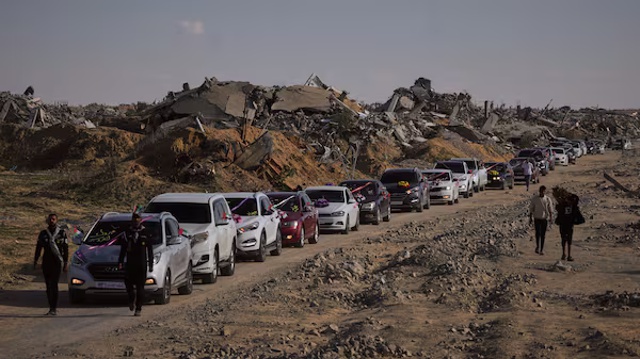
Dozens of Palestinian couples walked hand-in-hand through the shattered streets of southern Gaza on Tuesday for a mass wedding ceremony that offered a rare moment of joy after two years of Israel's genocidal war and devastation. Eman Hassan Lawwa was dressed in traditional Palestinian prints and Hikmat Lawwa wore a suit as they walked hand-in-hand past the crumbled buildings of southern Gaza in a line of other couples dressed in exactly the same way. The 27-year-old Palestinians were among 54 couples to get married Tuesday in a mass wedding in war-ravaged Gaza that represented a rare moment of hope after two years of devastation, death and conflict. "Despite everything that has happened, we will begin a new life," Hikmat Lawwa said. "God willing, this will be the end of the war," he said. Weddings are a key part of Palestinian culture that have become rare in Gaza during the war. The tradition has begun to resume in the wake of a fragile cease-fire, even if the weddings are different from the elaborate ceremonies once held in the territory. As roaring crowds waved Palestinian flags in the southern city of Khan Younis, the celebrations were dampened by the ongoing crisis across Gaza. Most of Gaza's 2 million residents, including Eman and Hikmat Lawwa, have been displaced by the war, entire areas of cities have been flattened and aid shortages and outbursts in conflict continue to plague the daily lives of people.The young couple, who are distant relatives, fled to the nearby town of Deir al-Balah during the war and have struggled to find basics like food and shelter. They said they don’t know how they’re going to build their lives together, given the situation around them. "We want to be happy like the rest of the world. I used to dream of having a home, a job, and being like everyone else," Hikmat said. "Today, my dream is to find a tent to live in.” "Life has started to return, but it's not like we hoped it would," he added. The celebration was funded by Al Fares Al Shahim, a humanitarian aid operation backed by the United Arab Emirates. In addition to holding the event, the organization offered couples a small sum of money and other supplies to start their lives together. For Palestinians, weddings are often elaborate dayslong celebrations, seen as both an important social and economic choice that spells out the future for many families. They include joyful dances and processions through the streets by massive families in fabric patterns donned by the couple and their loved ones and heaping plates of food. Weddings can also be a symbol of resilience and a celebration of new generations of families carrying on Palestinian traditions, said Randa Serhan, a professor of sociology at Barnard College who has studied Palestinian weddings. "With every new wedding is going to come children and it means that the memories and the lineages are not going to die,” Serhan said. "The couples are going to continue life in an impossible situation.” On Tuesday, a procession of cars carrying the couples drove through stretches of collapsed buildings. Hikmat and Eman Lawwa waved Palestinian flags with other couples as families surrounding them danced to music blaring over crowds. Eman, who was cloaked in a white, red and green traditional dress, said the wedding offered a small moment of relief after years of suffering. But she said it was also marked by the loss of her father, mother, and other family members who were killed by Israel. "It’s hard to experience joy after such sorrow," she said, tears streaming down her face. "God willing, we will rebuild brick-by-brick.” Since October 2023, the Israeli army has killed nearly 70,000 victims in Gaza, mostly women and children, and injured more than 170,900 in the more than two-year war that has left much of the enclave in ruins. Thousands of Palestinians have turned out in Gaza's Khan Younis to celebrate the wedding of 54 couples who had been unable to tie the knot during Israel's bombardment of the strip. People scrambled to secure whatever vantage point they could reach, even climbing over the crumbled ruins of buildings, to watch the spectacle. With as much precision and planning as could be managed after two years of war, the couples lined up to enter the ceremony — the women dressed in matching white gowns with red and gold embroidery, and the men in dark suits and maroon ties. Many of the newlyweds, as well as those watching on, carried the flags of Palestine and the United Arab Emirates, a significant aid donor and contributor to the wedding. With drummers and dancers taking to the stage, and the congregation sitting on plastic chairs or simply standing in the street, it was unlikely the special day the couples had dreamed of. However, many had feared it would never come — and the wedding provided respite from the difficulties of living in massive tent camps for displaced Palestinians across the strip. "Before the war, I was engaged and we lived in a house, and now I am going to live in a tent in the middle of the destruction and pain that we live in," 17-year-old bride Adeem Eid said. The ceasefire in Gaza had provided the opportunity for the event, following other ceremonies such as school and university graduations. Even though the truce has technically been in force since October 10, Israeli strikes across the strip have not stopped. The military insists it is enforcing the deal and targeting Hamas militants for violations of the agreement. But Palestinian health authorities have reported 356 people killed and more than 900 injuries in Israeli attacks since the ceasefire began more than seven weeks ago, pushing the death toll since October 7, 2023 past 70,000. A large majority of those are reported to be civilians, and many are women and children. Over the weekend, the Israeli military said it had opened fire on two "suspects" who crossed the so-called Yellow Line — the boundary of Israeli and Hamas-controlled territory — claiming that the pair were acting suspiciously and posed a threat to soldiers. Their families later reported the pair, killed by drones, were brothers. The oldest was just 10 years of age. Three Israeli soldiers have been killed since the ceasefire began, attacked by Hamas fighters inside Israeli-controlled areas. During the ceasefire, the bodies of at least 26 of the 28 dead Israeli hostages have so far been handed over by Hamas. Late on Tuesday, more remains were delivered to Israeli authorities to be examined by the country's forensic centre. As roaring crowds waved Palestinian flags in the southern city of Khan Younis, the celebrations were dampened by the ongoing crisis across Gaza. Most of Gaza's 2 million residents, including Eman and Hikmat Lawwa, have been displaced by the war, entire areas of cities have been flattened and aid shortages and outbursts in conflict continue to plague the daily lives of people. Weddings are a key part of Palestinian culture that have become rare in Gaza during the war. The tradition has begun to resume in the wake of a fragile ceasefire, even if the weddings are different from the elaborate ceremonies once held in the territory. Eman Hassan Lawwa was dressed in traditional Palestinian prints and Hikmat Lawwa wore a suit as they walked hand-in-hand past the crumbled buildings of southern Gaza in a line of other couples dressed in exactly the same way. But Palestinian health authorities have reported 356 people killed and more than 900 injuries in Israeli attacks since the ceasefire began more than seven weeks ago, pushing the death toll since October 7, 2023 past 70,000. A large majority of those are reported to be civilians, and many are women and children. Over the weekend, the Israeli military said it had opened fire on two "suspects" who crossed the so-called Yellow Line — the boundary of Israeli and Hamas-controlled territory — claiming that the pair were acting suspiciously and posed a threat to soldiers. Their families later reported the pair, killed by drones, were brothers. The oldest was just 10 years of age. Three Israeli soldiers have been killed since the ceasefire began, attacked by Hamas fighters inside Israeli-controlled areas. During the ceasefire, the bodies of at least 26 of the 28 dead Israeli hostages have so far been handed over by Hamas. Late on Tuesday, more remains were delivered to Israeli authorities to be examined by the country's forensic centre.