Oldtime actress Baharan

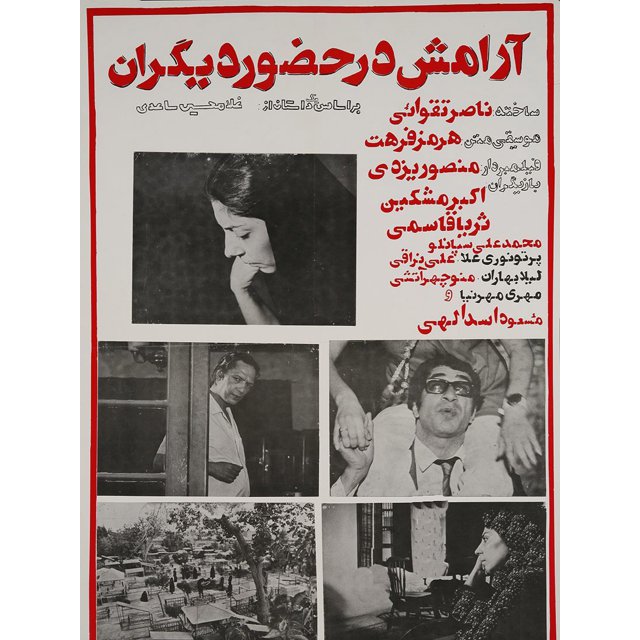
His first major feature, Tranquility in the Presence of Others (Aramesh dar Hozur-e Digaran, 1972), was a milestone of the New Wave. Based on a story by Sa’edi, it explored psychological repression within a military family — a microcosm of Iranian society under authoritarian rule. The film was banned for several years, but critics hailed it as one of the most profound works of pre-revolutionary cinema.  The show’s nuanced characters — especially the naive narrator and the larger-than-life “Uncle Napoleon” — allowed Taghvā’i to explore themes of love, delusion, and the absurdities of authority.

Despite being set in a family courtyard, the series subtly commented on political realities. It remains one of the most beloved works in television history and a rare example of literary adaptation surpassing its source in popular imagination. In the 1980s, Taghvā’i returned to his southern roots with Captain Khorshid (1987), a loose adaptation of Ernest Hemingway’s To Have and Have Not. Set along the Persian Gulf, the film transforms Hemingway’s Cuban smugglers into sailors and fugitives, combining elements of adventure, fatalism, and moral complexity.

Check Also

The Sacred Guardian of Shahr-e Rey

Shahr-e Rey, often called simply Rey, is one of the oldest continuously inhabited cities in …