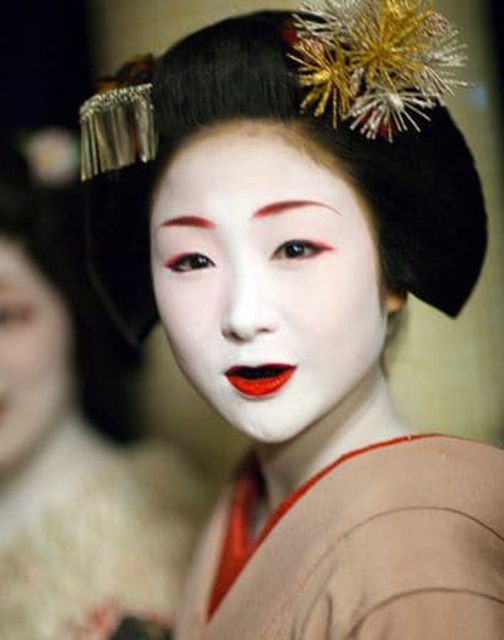
Even now, when walking the streets of Kyoto, Japan’s old capital, it’s not uncommon at all to meet a maiko with pitch black teeth. As you might now, during the end of the Edo period and the beginning of the Meiji era, Japan was visited by Western foreigners after almost 200 years of seclusion. Being used to Western beauty standards, many a visitor was shocked to see women with black teeth walking around. Some thought that the Japanese people had terribly bad mouth hygiene, mistaking the dye for actual tooth rot, while others, having realized that the blackening was done on purpose, wondered why Japanese women would “disfigure” themselves with ohaguro.
A theory, stemming from that very time of the first cultural exchange, claims that ohaguro was done to prevent the woman from cheating her husband, and the black teeth were indeed used to make her less attractive. Modern Japanese social scientists dismiss this theory, though, stating that Japanese girls and women enjoyed a lot of liberty in their lives and stress the original tradition of ohaguro: to show someone’s maturity.