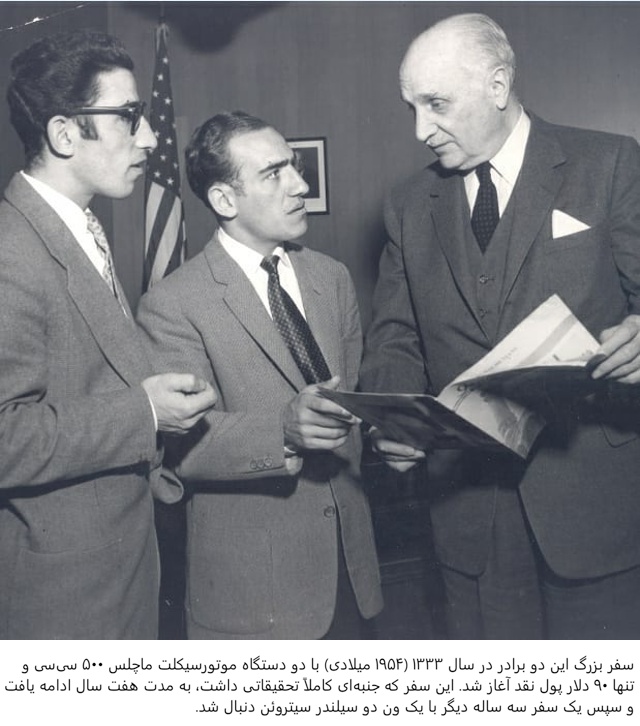
Their first expedition began on British-made Matchless motorcycles. Starting they traveled eastward through Afghanistan, Pakistan, India, Southeast Asia, and Australia before crossing the Pacific Ocean to North America. From Alaska and the Arctic regions, they journeyed south through Canada, the United States, Central America, and the Andes of South America. Later, they continued their travels through Africa using a Citroën 2CV vehicle. Throughout these adventures, they documented tribal societies, indigenous rituals, and traditional lifestyles that were rapidly disappearing in the face of modernization.
The Omidvar Brothers were not merely travelers; they were also filmmakers, photographers, and ethnographic researchers. Their documentaries captured Inuit communities in the Arctic, Amazonian tribes, African pygmies, Polynesian islanders, Aboriginal Australians, and many other groups rarely seen by the outside world during the 1950s and 1960s. Their work is considered a significant contribution to early travel documentary filmmaking and cultural preservation.