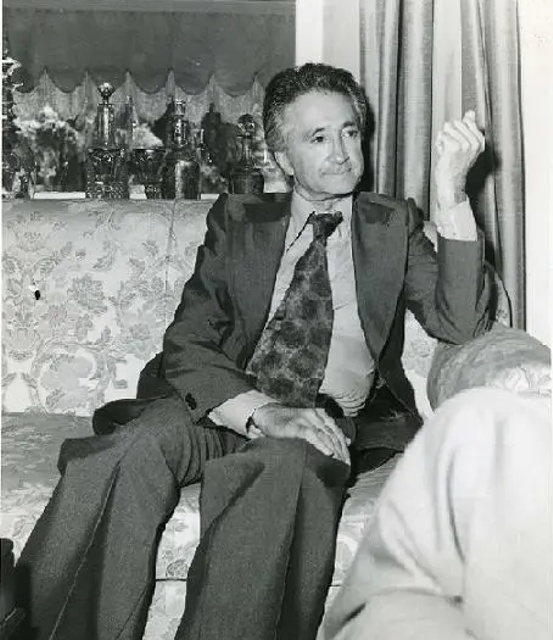
Farrukh Ghaffari (February 26, 1922-December 17, 2006) was a film director, actor, critic and author. He studied in Belgium and at the University of Grenoble in France in 1945. Ghaffari, along with Ebrahim Golestan and Fereydoun Rahnema, was a key figure in the early New Wave Cinema. In 1949, he established the National Film Center, initiating screening sessions for English-language films. Ghaffari also founded the National Film Archives in Tehran. Ghaffari pioneered neorealist films incinema with Junub-i shahr (South of the City,1958), which the Pahlavi government banned for its portrayal of working-class poverty.
In 1964, Ghaffari directed Shab-i quzi(The Night of the Hunchback), a dark comedy adapted from tales of One Thousand and One Nights. Ghaffari starred alongside Mohammad-Ali Keshavarz in the film. He later worked for National Television and directed his final film, Zanburak (The Falconet) in 1975. Farrokh Ghaffari was in charge of the Shiraz Arts Festival, an event dedicated to dramatic arts and music, held from 1346 to 1356. After the 1979 Revolution he moved to Paris and worked as a film critic for Positif.