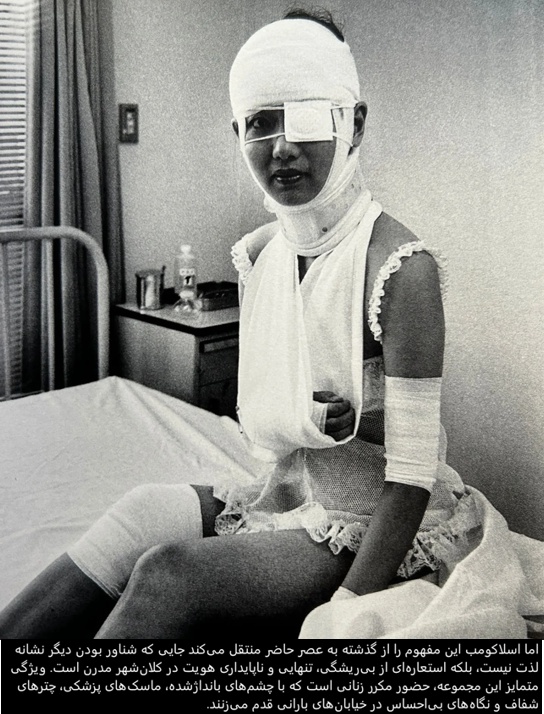
Visually, the book possesses a distinctive identity. The stark black-and-white contrasts, coarse film grain, rain-soaked streets, and transparent umbrellas that recur throughout the images create an atmosphere reminiscent of film noir and Japanese psychological cinema. Slocombe’s Tokyo is not the city encountered by tourists. It is a city where, despite the constant crowds, the individual experiences a deeper sense of isolation than almost anywhere else.
This concern with the body as a site of memory has appeared throughout Slocombe’s career. In projects such as Broken Doll City, he repeatedly investigates the relationship between physical vulnerability and social anxiety. Across his work, scars, bandages, prosthetics, and medical imagery never function merely as documentary details; they become visual languages through which broader cultural conditions are expressed. Bodies absorb history. They carry evidence of invisible pressures that cannot easily be represented through architecture or landscape alone.